Friday, May 26, 2023

Let’s create some magic !


Sometimes I wish I had a magic wand to create more time..the days have just flown by and I hardly had time to do anything else but prepping, dyeing, spinning and feeding Bob…yes, Bob: I decided to start on my sourdough starter and bread making journey after the handknitters guild show and named my starter Bob…lol. I know I am super late to the party of sourdough bread making and I don’t really know what I am doing, but the starter …sorry I mean Bob…looks bubbly and happy so I think I’m going to try my hand at making a loaf this weekend. I’m a bit intimidated by the fact that making sourdough bread seems to take days..so I will let you know what happens… in the meantime I am going to keep making my “regular” yeast breads because , well, the masses need to be fed.

If the sourdough starter, Bob, performs well, I will upgrade him to King Bob 🤣


I have found an especially tasty nut bread recipe from Emile Henry’s Instagram page. Made it once (easy peasy) and it was a big hit…why mess with perfection eh?lol

Here’s a photo of that yummy bread:

for the recipe just go the Emile Henry Instagram page and look at their bread week recipes ! It’s well worth it!

Anyway! Magic is everywhere..not necessarily in creating time, but we can make all kinds of things from scratch, plain air plus some ingredients plus a lot of imagination. That goes for anything! Cooking, baking, spinning yarn !, knitting, felting, sewing. Whatever you do, you are creating something unique and special. The magic ingredients I believe are passion and love. 
have you ever found that when you are upset, or stressed or feeling very sick you cannot concentrate or make something? Well, I have…it takes a bit of calming yourself and find that little piece of quiet and magic, inside yourself. When you do…everything seems to fall into place. And, even more important than that: by spinning yarn or knitting or painting, doing anything you love doing, will make you feel less stressed! It’s like the gift that keeps on giving!

Here I am going on a tangent again … where was I? Oh yeah..I wish I had a wand to make more time! 
So, what has been going on? Lots! Of course..lol almost important things were getting all the May clubs dyed, carded, prepped (not necessarily in that order..lol), dry, labelled, packed, write up the art journey information sheets that go with the clubs and getting all the parcels ready with their shipping labels and then driving to the nearby post office to deliver that truckload of fluffy colourful happiness just in time for the Australia Post truck to get it on Board. That last bit happened early this morning! Yeah!!! A week late …for which I humbly apologise. Doing a big show that needed lots of prep and dyeing etc took a lot of time and unfortunately I still don’t have either that magic wand or the ability to clone myself ( not that I would ever want that! Too scary…lolol. )

I posted a teaser label on last weeks blog : Alphonse Mucha with his design for the poster Gismonda from 1894. I will share photos of all the May clubs in the course of the next week or so.

Next week I will be dealing with a mountain of fluff to prep and card for the June club, which will..I promise!!..be shipped as usual mid month and it will be AMAZING!

Please do keep an eye out for the June Club teaser label posts which will be appearing on my Facebook and Instagram pages next week!

so much to look forward to!!

For this weeks shop update I offer you Magic Bunny tops AND some freshly harvested angora bunny fibre tops :  I was in a magical mood plus it is getting pretty cold here (there is fresh snow, about 3cm, on mount Donna Buang and there will be more tomorrow). Here, a bit lower down, we only have very big, heavy drops of rain. I have taken a video..will have to share that with you later…

Don’t forget: sign ups for the third quarter (July, August, September) are open now!  

on a side note: I was totally taken aback this week by a comment on social media on one of my replies where I was showing off some sock yarn…A person more or less mentioned:  “i stay away from IxCHeL..coz of bunnies. I have bunnies and I don’t want them to be hurt”. Now you would think that after doing what I do for over 20 years , and dealing with all kinds of abuse and misinformation and downright harassment, mainly by people who believe in the things that Peta are saying about mistreatment of bunnies, that I would have gotten used to this. I obviously have not,because it hurts like hell when you get these kind of remarks slung at your face. I know it’s down to misinformation and the fact that people assume and not even ask, but yeah.. I have to keep explaining that “no bunnies were harmed getting their fibre. They get combed every day and have a haircut every three months while they are getting patted and given snacks”. Our animals are our family. Have a look at our logo! I am cuddling a bunny! I thought it would be a good idea though to put this message up on my blog again.

I always say: be critical but never assume, always ask if you have any questions ! 

Have a wonderful weekend! Let’s create some magic !


big hugs

Charly


Friday, May 19, 2023

Curiouser and curiouser

A fluffy wonderland awaits

“We’re all mad here”, The Cheshire Cat says to Alice in one of the most concise descriptions of the strange world down the rabbit hole. Unlike the world Alice left behind, "mad" isn't necessarily a bad thing. Here (and as you're reading), you should embrace a side of you that is quirky and unpredictable, and maybe when you get back to reality, you'll want to take a little of that with you. And, that’s just what I do all day, every day.
Writing Alice in Wonderland, one of my favourite literary works in the world, even Lewis Carroll could not have imagined the absolute fluffy wonderland we have tried to take with us last weekend at the handknitters guild show.

People who have known me for years recognise that I am, to say the least, driven. Driven by the desire to enable everybody who comes close with colourful mountains of fluff. I see a yarn and fibre show as an event, a celebration and a way to immerse yourself in a total fluffy and colour explosion of fun! I guess that drives me to produce wayyyyyyy more than I could possibly ever sell at an event🤣 but hey, you had the “wall of sound” of the sixties , why not have the “wall of Fluffy Colour” ?! 

To recap: we had an amazing time at the show last weekend! It was awesome (see: all the superlatives are coming out to play 😜) to meet all my crafty friends again AND make new ones! Doing these kind of events are fun but also very, very intense! I’m not talking about being AT the show and enabling all the people who come and visit our stall. I am talking about the months and months of producing, dyeing, spinning, skeining, labelling, dyeing, dyeing and blending and carding and so, so much more… not to mention the gargantuan task of setting a space up to look like a fluffy Wonderland of Fluffy Colour in a mere two hours before the floodgates  open and let all the people in to wool and yarn dive. 

here is a video and some photos of the IxCHeL wonderland of Colour stall at the show:

Click on the YouTube Ixchelbunny channel here : 

https://youtu.be/cgxZOV7KRYs

 Show wall of fluffy colour 1


What does being at a big yarn and fibre event mean? On your feet for two days and then….packing everything up again in record time, ready to drive your whole magical Wonderland back home and…unpack, organise and add to the online shop. 

I was super lucky : Paul has done all the stock taking and shop update stuff ( “doing at least six impossible things before breakfast” as is described in Alice in Wonderland), while I was tackling custom orders and getting straight back into the dye room getting the May clubs ready for shipping nxt week! Fingers crossed for nice, warmer and dry weather!!

i lost track what I did and didn’t tell you, so if I repeat myself I am sorry..lol. Here’s a teaser label of the May clubs by one of my fav artists Alphonse Mucha. THE quintessential look of the Art Nouveau movement, much lauded by his muse and patron the actor Sarah Bernhardt. Writing the whole background information for all the clubmembers to enjoy atm.

here’s a sneak peek of the label and the dyeing process of the yarns😉


Yes, eh, I re-use ice cream containers to prep some of my pigments 😜

I have been asked at the event if I will be going to the Bendigo show this year….in short: no.

I love to support fabulous organisers like the handknitters guild who do an absolutely fantastic job taking care of their stall holders (big shout out to Susan McDougall and ALL the volunteers at the show!!). The Bendigo show this year I cannot possibly be at because of so many reasons but mainly, it takes a LOT to prepare and invest and dye and do things like I want them to be. I guess I’m a bit OCD about the whole thing but support flows two ways: a show needs their stallholders and stallholders need a fabulous event that supports them too, especially when times are tough for everybody. I know my limits. There’s only so much I can do. So I choose to do what I can. No compromise. That means I cannot be everywhere at the same time or at once unless I invent a TARDIS or a mini me, and especially that second image would be just too frightening for the world 🤣😂 There will be weekly shop updates and more coming. I do thing about at least six impossible things before breakfast…so nothing is off the table I guess🤣

So, what’s up  and NEW on tonight’s update?!? 
so many things, like this and much, much more!

I have spun lots of fluffy yarns and made lots of scrumptious batts for you to feast your eyes on: there are pure angora yarns, vampire deer yarns, wallaby yarns and so, so much more!

Heres a peek into the fluffy fun stuff: 

 From batt to yarn…

all is available on the shop in the yarn and batt section.

If there are any colours that you see are either sold out or I haven’t listed: please let me know! Anything goes! If you would like a yarn in a particular colourway or colour: ask! I am very happy to talk you through your colour choices for your projects. It’s fun! And I am here you! I will gladly and safely guide you through the rabbit hole !

This weekend  and the upcoming week is all about getting the May club dyed and ready to ship, so I will spend most of my time at the carder and dye room, plus labelling and writing. Never a dull moment here at the IxCHeL fibre farm!

I wish you a fabulous week filled with magical crafting!

big hugs

Charly


Friday, May 5, 2023

Mountains of fluff and yarns


The weather is becoming a bit wild and woolly here...which means the fire is on, ready to warm the house but most importantly: getting the mountain of yarns and fibres ready and dry for the handknitters guild show at the Merri-Bek hall in Coburg on May 13th and 14th. In my mind I thought at one point that we were still in April, but hey, that was wishful thinking for sure!  With only a week to go to get all the yarns dry, skeined up, labelled and packed it is starting to become a mad scramble again…lol. I guess that’s  my modus operandi I cannot escape from..lol. Studying for exams or preparing for shows: why do I always seem to leave things til the very last minute to get everything ready? One day, I will start preparing even earlier and will sip cocktails on the verandah, relaxing, instead of this mad hatters party eality I’m living in…rofl. Never mind!  I can always relax AFTER the show!
don’t forget to book your free tickets ! And get all the information about what is going on when you scan the QR code on the poster here:
Handknitters guild show 2023 poster
This week has all been about dyeing, dyeing and …dyeing plus plying the handspun angora yarns, wallaby yarns, guanaco yarns and more! I’m afraid I have let the social media stuff escape me for a bit due to lack of time but I hope, fingers crossed , I will get a chance to post preview photos of all the yarns and fibres hopping to the show with me, together with magnificent spindles, nostepinne, wrist distaffs and bowls made by Paul aka Lair of the bearded dragon. 

I am also prepping and dyeing the May clubs next week! The shipping of the away club will be a tiny bit later than usual but I am hoping to get everything dry and ready a bit later than mid May. The teaser labels will appear on social media this weekend so make sure you follow me on Instagram where I am @ixchelbunny 💕🐰💕
Now, where was I? Oh yes!! The handknitters show or let’s just call it “the fabulous fondle of fluff & yarn weekend” of the year! 

what can you expect?
short answer to that is : A LOT!  There will be heaps of super interesting and fun vendors there selling their handdyed yarns and I will be there as well with the Bearded Dragon himself, in our stall, the first on the left as soon as you walk in the entrance door to the show.
I did post some videos of last years show on social media so if you would like a sneak peek of the happening, please do!
What will be on offer?
short answer? A LOT!
Here’s a list to help you organise a shopping list:
Yarns:
handspun angora 
handspun angora wallaby
handspun angora possum
handspun guanaco and vampire deer yarns
sock weight yarns spun in Victoria and dyed on the IxCHeL farm, ranging from fun speckles to saturated semi solid colours
Silver Star sock yarn superfine merino cashmere and bling! Handdyed fabulous fun and super soft!
luxurious merino silk and cashmere sock weight yarn
IxCHeL merino/mohair and fine lambswool tweed yarns in over 20 colours!
Gaia DK yarns hand dyed speckles to variegated and semi solids
Fibres
ALL THE FIBRES I HAVE IN STOCK in the shop will be going to the show! Together with drop spindles, bowls, dealgans, support spindles, phangs, bowls and all the tools. 

o-oh! I think I need a “bigger boat” to get everything to the show😜🤣😂


This week I have a fab blend for you on offer : 
A Ouessant/Blue Faced Leicester/Mulberry Silk blend that is so smoochy and soft and fluffy you have to try it ! The different colours in all the fleeces blended together made a gorgeous base to dye on and resulted in amazing tonal values of the dyed tops. 
I love dyeing tops that have different coloured fleeces in them: it is magical ! spinning this blend will give you a gorgeous heathered and saturated, magical colour play yarn, that is soft and suitable to close to skin wear with a gorgeous drape.


Located 12 miles off the French coast in the Sea of Iroise, the island of Ouessant (or Ushant in English) is the original homeland of Ouessant Sheep. 
 Ouessant sheep are the most primitive of the native French breeds. For centuries, they were raised in isolation on the island where they played an integral part of the self-sufficient closed economy, providing both wool and meat. By the end of the 18th century there were over 6,000 sheep on the island of Ouessant. But economic improvements along with a move toward modernization at the beginning of the 19th century radically changed the future prospects of this small primitive breed. ortunately, in the late 1800s and early 1900s, a number of wealthy families imported small numbers of traditional Ouessant sheep to the French mainland to graze the lands around their estates. 
Ultimately, this seemingly insignificant event insured the survival of the breed. Today, Ouessant sheep are sought after both as companion animals and as “environmentally-friendly lawn mowers”. 
They have also gained a certain amount of popularity in several different European countries : Most notably Belgium, Germany, the Netherlands, and Great Britain. 
A member of the Northern European Short-Tailed breeds, Ouessant sheep are distant cousins of the Shetland and Icelandic breeds. The two most distinctive features of Ouessant sheep are their size and their color. 
Considered by many to be the smallest breed of sheep in the world, adult ewes measure less than 18″ (46cm) at the shoulders and rams are under 20″ (50cm). 
Additionally, Ouessant sheep come in a number of different colors : Including black, white, brown, and grey. It is true that the small size of Ouessant sheep contributes to the breed’s characteristic charm and appeal. However, their diminutive size also means that the breed is not commercially viable in the modern world of agricultural production. In fact, one of the primary objectives for breeding Ouessant sheep today is the preservation and conservation of the rare genetic resources that are found in the breed. 
Despite their small size, these charming little sheep produce a particularly beautiful and versatile wool. Ouessant sheep have a distinctive double-coated fleece with an average fiber diameter of 25 microns and, on average, fleeces weigh approximately 750 grams (1.5 lbs.). It is important to keep in mind that Ouessant sheep are an unimproved breed, which means that from one sheep to another there is less standardization and more variability in wool type and quality than one would normally find in modern improved breeds. 
For the handspinner, this variation presents a unique opportunity : From one small flock of Ouessant sheep it is possible to produce wool that can be used for a wide variety of projects, ranging from lace shawls to hats, cardigans, and even rugs. 
 I have taken great care to only select the finest of the Ouessant fibre and blending that with the shiny Blue faced Leicester and the mulberry silk  to create a beautiful heathered effect when dyed.


RABBIT ON !
((hugs))
Charly

Friday, April 28, 2023

Gothic Happenings


Sometimes there is so much going on that you don’t even know where to start…that is basically how my week has been.

Every year for the last twenty years I have been doing lots of big wool and yarn shows and even weekly markets, hey, even two or three markets a week. So I know what busy looks like and feels like, but big yarn and wool shows are another beast altogether. Well, at least that’s how I treat them going by the saying “if you don’t have it, you can’t sell it”..lol

my production schedule is hectic at the best of times with weekly updates and custom orders plus the monthly art journey club to produce, but adding a show is a whole other level : it means , for me at least, that I get even less sleep because I tend to dye during the day, let everything rest before rinsing it all the next morning and spinning and plying at night, with brief intermissions of cooking and feeding all the animals including Paul..or as I often call it from one cooking pot (the dye pot) to another…lol

I have been dyeing tens of kilos of yarns and spinning so much, I think if I would fall asleep at the wheel, my body is so accustomed to the repetitive action, I can just keep going while I doze off…rofl..it has happened before…

I wonder how many of you who spin yarn have fallen asleep at the wheel? I’d love to know!

Preparing for a show always is a bit more tense than usual and because so much is happening at once, drying,skeining, labelling, I tend to forget to commemorate the whole thing with photos or videos. I so have to get into the groove with that because it probably will make me feel less guilty not putting all the yarns and extras on the shop while they are getting ready for the show. Let’s see if I can reprogram myself to do that.

This weeks update is something super special though: very shiny and special. Paul has made some amazing semi precious stone inlay phangs and I have been prepping and dyeing gothic tops for this update (and the show coming up at Merri-bed town hall in Coburg, Melbourne, on May 13th and 14th)

I feel very strange saying this but there’s not much else to report : just working working working from early morning til about 3-4am in the morning…

I promise i will have some exciting stories next week! Something to look forward to😜


Here’s the link to all the new gothic and phang happenings plus fab GLOW in the dark yarns on the IxCHeL shop: https://ixchel.com.au/collections/whats-new

Wishing you all a wonderful weekend and happy crafting!

big hugs

Charly

Friday, April 21, 2023

Precious fluff and spindles !


Another exciting week, especially if you are an “eclipse hunter”. People in Western Australia were extremely lucky to witness a full eclipse of the sun, while we, as usual when any major astronomical event is taking place, were stuck staring at clouds 🤣 Thankfully there was a live streaming opportunity so we could watch it even though we were nowhere close:  All hail to technology 😜

I may sound like a bit of a broken record, but it was another busy week here: lots and lots of yarn dyeing and spinning. With the weather being so wet and woolly, I have a hard time getting anything dry, so unfortunately for today, I can only offer you the brand spanking new blended Precious tops undyed, BUT I do offer a custom dye service at no extra cost as usual. The only thing you need to do is add a note to your order saying which colour you would like and I will dye it for you. Anything goes! You can of course contact me at any time to discuss any specific colourways you’d like to see as well. To check it all out please go to www.IxCHeL.com.au and look for guanaco blends or go to the “what’s new section” in the drop down menu.


Back to what is going on here: prior to the handknitters guild show coming up on May 13th and 14th, I try and add as much yarn stock that I can manage. I know I am normally focussing on dyeing fibres and blending fibres and that’s what lots of people know me for, but I do heaps of yarn and custom spinning as well. It’s a bit of a time issue. I wish there was more time in the day to do everything I would like to do, but unless I find myself a gadget that makes time travel possible or make time go slower while I go full steam ahead with every thing on my to-do list, that is unfortunately not on the cards…lol

at the moment ups am spinning wallaby-bunny-cashmere-merino-silk yarn and I have just finished spinning angora yarns which still need to be dyed. Now, you may ask yourself “why do you spin  everything By hand instead of having it all spun by machine by a company for you? Well, that’s easy: I don’t have the quantity of angora bunny fibres nor do the big mills even want to get close to any angora fibres because it is quite challenging even for machines… in short, I would need a few hundred kilos and a ton of money to have it all done by a big industrial mill. I have always said that my goal was not to become a big business, but to remain sustainable, small and able to change up blends and colours. Big industrial processes do not have that luxury. So while it may take time that I am short of, my way of producing yarns and fibres are sustainable plus I am very, very adaptable. I can change up colourways, types of fibres and ply in an instant. And then, of course, there is the investment money wise. since I am not exactly a rich investment banker, money as well as time come in short supply. Limited resources: And in a way I think that is a good thing! That way you have to make choices, try to think ahead and be sustainable. It is not all about growth like the economists and the government tell us, it is about balance and creating what we love.

Paul aka Lair of the Bearded Dragon, has been super busy again and he has been making beautiful drop and support spindles and some nøstepinne too. Some with gorgeous stone inlay like malachite, azurite and rose quartz. You can find them all in the what’s new section on the IxCHeL website (www.IxCHeL.com.au).
I hope you will be able to come and visit me and Paul at the  handknitters and crochet guild show in May and to check it all out please scan the QR  code on the poster: 


All the April yarn, fibre and fibre clubs have been shipped out last Monday so hopefully all the club members will have received or will receive their fluffy surprise parcels very soon! I have posted a teaser video of the batt club on my social media, so be sure to follow me there (@ixchelbunny) to get more day to day insights on my “colourful life in fluff” 😉

The new third quarter clubs sign ups are open on the website btw, so please don’t hesitate to join the fun! I will be sending club membership reminders out to all the combination club members..aka all those who have signed up for a combination of yarn, batt and fibre clubs next week. If you have not joined yet, please feel free to join in the fun of receiving an art work inspired surprise parcel each and every month for three months! It’s a wonderful way to explore different fibres and yarns and colours and you can read something about a very inspiring artist if the month as well. You can find all the clubs here: https://ixchel.com.au/collections/clubs


I am going to spend the next week, with lots more fibre blending for future updates, heaps of yarn spinning and planning some pretty special new fluffy products to make their entrance on the website again soon! It’s a very exciting and busy time here at the IxCHeL fibre farm 💕
have a wonderful creative weekend !

hugs
 Charly

Friday, April 14, 2023

Super cute & Fluffy


Have I got a treat for you tonight: A freshly blended rare breed adventure, because life gets wayyyyy more interesting when you add new adventures doesn't it? Especially the fluffy and cute kind of adventures.
But before I start talking about  that, I am going to share a bit of what my week looked like...not really very adventurous but packed to the rafters with so much to do !!! And then of ocurse my brain has this "brilliant" idea  of organising a virtual egg hunt of Easter on the website. LOL... The best way to describe to anybody who I am, is by the quintessential typical conversation of a few lines with Paul I frequently have:

Me: " OMG, I just had this fun idea!! I am so excited !!"
Paul : ....silence...with an eyeroll and a smirk....
          "Oh no....there we go again..."
Me: " Whaddayamean? again?..."     giggle
Paul : "Well, your fun ideas always mean a ton of extra work:" .....
            followed by a grin like a Cheshire cat

Yes, that is what happened again ...No relaxing for this Easter bunny...
(Felted) eggs to hide here, there and everywhere on the website and trying to figure out the tech issues involved to make it work ! What did I get myself into..again?! lolol 

But hey, it was heaps of fun!! I hid loads of eggs, it took me a full day to organise and take photos and get the tech stuff to work and...the eggs got found in a record time of FIFTEEN minutes !!! gigglegiggle

Congrats to all the Egg hunters who won an IxCHeL gift voucher !!
I am so happy everybody had a great time and telling me with numerous facebook, email and insta messages about how much fun it was! Yeah !!! mission accomplished ! Next year, I will have to so make the egg hunt a bit harder and more fun, but I am sure my brain will come up with something by then...lol
What else? Oh yes, the April Clubs are all dyed ! Unfortunately the weather here was pretty wet so my self imposed deadline of getting everything shipped out today was not accomplished, BUT all the club parcels will go out on Monday morning ! Yeah !!! 
This is the teaser label of the April club. It is a pastel painting by Giovanna Fratellini (Cecilia Pazzi portrait) from 1717 !  Here it is together with a self portrait of Giovanna :


What drew me in to this artwork was not only the beauty but also quirkiness of it: the powdered wig young girl with  big smiling eyes holding a squirrel….yes, a squirrel ! Coz I mean, who doesn’t have a pet squirrel? Lol

The colour palette can only be described as pastel with a bright blue sky and I my "translation" of this artwork onto fibre and yarn reflects the essence of the painting.   

The biggest challenge for me, who always has vibrancy and colour saturation on their mind, was to create this "powdery look". This pastel look that Giovanna created so beautifully.
Taking into account that i am not working with oil pastels nor paper or canvas but with liquid pigments and fibre and yarn, it was a big challenge. As usual I have adapted the blend for the artwork as well (more will be revealed later...don't want to spoil it for all the club members! but it is pretty and special ) ; the sock yarn is a bit more involved, because I not only tend to create the painting by the colours it has but also with the subject matter, the action of movement in the painting and the arrangement/interaction  of the colours.
In short: I tend to paint the yarn.. yes, literally paint. This time, because it involves superwash yarn, which reacts extremely sensitively to temperature of the liquid pigments, I opted to paint with cold temperature pigments rather than hot. If you were to "paint" onto superwash yarn with hot/warm liquid pigments it sucks the dye up immediately and very strongly...that would totally defeat the powdery look I needed to achieve. And, as with pastel and water colour painting, once you add colour to your fibres or yarn, you cannot say "Oops, I made a mistake! Ill just get the big eraser out " once it is on it is there forever. lol
Here's a bit of a sneak peek of my work of the first layer before the later manipulation of glazing with more colours to reflect Giovanna's artwork.


When I am not in the dye room, I am either planning fun fluffy  stuff (LOL), preparing new blends or spinning !

I have a full huge tub filled with yarn cakes, waiting to be plied and dyed to take with me to the Handknitters and crochet guild of Victorias Yarn and Fibre weekend show in May with lots of spinning yet to be done. To spin our angora bunny  and also our rare breed yarns you have to know  it is all done by hand and by me. No big machinery to spin these yarns for me, nor do I get these precious yarns already spun by big companies in: all is done here on the IxCheL fibre farm and it takes a long time. It is not called slow fashion for nothing I guess...lol 
The good thing about this is that you know where it comes from, that the animals are well cared for  and loved and you are supporting a small farm business. But, like I said, it takes a lot of time. Just with any resources of this planet, everything I offer you on the website but also at the yarn and fibre shows is done with love and time and care: there is only a finite amount I can do. I could try and stay up even longer and work more hours but I think I am at the limit already. I am super fortunate to have a partner who helps me out and actually goes out into the real world and does all the grocery shopping and post office runs !

...ever since the pandemic started and maybe even before that as an introvert , I was not exactly a social butterfly...lol  but now, I only spend time with the animals, around the house and every now and again when I have to , go to doctors appointments.
Every single hour is filled with work or something work related. I often hop out of the dye room standing at one dye pot and go :”now it’s time to stand at the other stove to do dinner..” lolol
 For one who is always advocating sustainability, my actions towards self care are totally lacking in every sense of the word. I live for what I create almost 24/7. Some may say it is a very solitary way of life but I am okay with that. However, I am getting very, very, VERY tired ….no exhausted, by the self imposed deadlines and targets I set myself: weekly updates, monthly clubs and show prep etc.  
I am definitely going to have to have a stern talking to myself after the  handknitters guild show in May.. to get some time off, maybe even go out ! or ....shock-horror!!..on a holiday somewhere in Australia…somewhere sunny?? Where I can go diving and snorkeling and converse with fish and turtles ?!?!?!   LOL...we'll see ! I will definitely keep you posted! 
 
Tonight’s special adventure update is my out of this world blend with guanaco !!


Warning: There is only a tiny bit of this awesome fibre. Safe to say I have had to be extremely careful and not breathe too heavy because I cannot afford it being blown off in the wind never to be seen again; it is just too preciousssss: Guanaco.


It has always been a dream of mine to get my hands on the wonderful and super soft Guanaco and here it is: I concocted a blend that is literally so soft it cannot be described other than “orgasmic” ..yes, really. Lots of careful blending and calculating and trials have brought this blend to you comprising of 60% guanaco, Luscious Muga silk, Amazing cashmere and the ever lovely Angora bunny! As you can imagine, it is already extremely hard getting your hands on this fibre in normal times, but last year and this year with the Pandemic going on, have proven to be super tough. I am happy to say that all the almost super human effort has paid off !

So what is Guanaco and where does it come from?

Guanaco fibre is particularly prized for its soft, warm feel and is found in luxury fabric. The guanaco's soft wool is valued second only to that of the vicuña. The guanaco is double-coated with coarse guard hairs and a soft undercoat, which is about 16-18 µ in diameter and comparable to the best cashmere. Only the super soft undercoat is used in this blend and it is amazing !

The guanaco is an animal native to the arid, mountainous regions of South America. They are found in the altiplano of Peru, Bolivia and Chile . In Argentina, they are more numerous in Patagonian regions, as well as in places such as the Torres del Paine National Park, and Isla Grande de Tierra del Fuego. In these areas, they have more robust populations, since grazing competition from livestock is limited. Estimates, as of 2011, place their numbers at 400,000 to 600,000. A small introduced population exists on Staats Island in the Falkland Islands, with a population of around 400 as of 2003. Guanacos live in herds composed of females, their young, and a dominant male. Bachelor males form separate herds. While female groups tend to remain small, often containing no more than 10 adults, bachelor herds may contain as many as 50 males. When they feel threatened, guanacos alert the herd to flee with a high-pitched, bleating call. The male usually runs behind the herd to defend them. They can run at 56 km (35 mi) per hour, often over steep and rocky terrain. They are also excellent swimmers!! A guanaco's typical lifespan is 20 to 25 years. Guanacos are one of the largest wild mammal species found in South America (along with the manatee, the tapir, and the jaguar). Natural predators include cougars, jaguars, and foxes. Guanacos often spit when threatened, same as their alpaca and llama counterparts! To protect its neck from harm, the guanaco has developed thicker skin on its neck, a trait still found in its domestic counterpart, the llama, and its relatives, the wild vicuña and domesticated alpaca.


Mating season occurs between November and February, during which males often fight violently to establish dominance and breeding rights. Eleven-and-a-half months later, a single chulengo, or baby Guanaco, is born. Chulengos are able to walk immediately after birth. Male chulengos are chased off from the herd around one year of age.

Although the species is still considered wild, around 300 guanacos are in US zoos and around 200 are registered in private herds.


Another titbit of information: Guanacos are often found at high altitudes, up to 4,000 meters above sea level, except in Patagonia, where the southerly latitude means ice covers the vegetation at these altitudes. For guanacos to survive in the low oxygen levels found at these high altitudes, their blood is rich in red blood cells. A teaspoon of guanaco blood contains about 68 billion red blood cells – four times that of a human !

Some guanacos live in the Atacama Desert, where in some areas it has not rained for over 50 years! A coastline running parallel to the desert enables them to survive. Where the cool water touches the hot land, the air above the desert is cooled, creating a fog and thus, water vapour. Winds carry the fog across the desert, where cacti catch the water droplets and lichens that cling to the cacti soak it in like a sponge. When the guanacos eat the cacti flowers and the lichens, the water is transferred to them. So when they eat the cactus flowers they basically get a drink at the same time.


I'll have some guanaco handspun yarns plus some vampire deer yarns, together with  some very special wallaby-angora bunny. possum-angora bunny and lots of our own IxCHeL sock yarns, Silver star yarns, the whole colourful tweed range and our special organic GAIA 8ply yarns available at the handknitters and crochet guild show in May ! 

You can book tickets to this awesome  event on the try booking website and to know more just scan the QR code on the poster. 


Have lots of fun exploring the new adventures on the IxCHeL shop ! 

To find everything NEW go to www.ixchel.com.au and go to the "What's new section"

Big fluffy hugs,
Charly

Friday, April 7, 2023

Celebrating an ancient rare breed


It  is starting to get a bit MORE hectic than usual here: the handknitters guild show at the town hall in Coburg, Melbourne on May 13th and 14th is getting closer and closer! Plus there’s the weekly updates of course and the monthly clubs. Every year I am preparing some super special yarns for the upcoming show so I am spinning like mad every day and night plus getting much needed dye time in as well. It is all happening here! Again..lol
It is of course Easter weekend, which for lots and lots of people, means it is a holiday and a looooooong weekend! Not here at bunny central though! This time of year is super busy! And why my make it extra egg-citing with a fabulous event?!? Yes, you heard it right! Not only am I doing the usual Friday night shop update but also an Easter Sunday event at 12pm AEST ! Let’s call it an EASTER EGG HUNT event! More details will be released tomorrow on my social media Channels ! Please make sure you follow me on Instagram where I am @ixchelbunny 💕🐰💕
Now it is time to give you some more information on this magical ancient animal that is the focus of this blog update ! it is all about an ancient rare breed the Musk ox !
Qiviut is the name of the wool that comes off of the Musk Ox, a gentle giant of a creature often found in Alaska, but also in Norway, more specifically in the Dovrefjell National park. 
Once hunted to the brink of extinction, Musk Ox are now considered to have the most precious, softest fiber in the world. Eight times warmer than wool and finer than cashmere, qiviut is rare and it is one of the most luxurious fibres you can choose for a garment.


The softness of Qiviut is something that must be touched to be believed! Qiviut is not only soft, it is also non-irritating to the skin, and is very durable - garments made from it are worn for years and can be hand washed in mild detergent. It retains warmth even when wet. 

The lightweight fibre preserves heat in the winter, while also providing cool, breathable comfort in warmer weather. This fibre has been carefully gathered by hand and no animals were harmed in the gentle shedding of it. This fibre generally sells for anywhere between $70-$100/28grams/oz, and skeins of yarn often sell for a lot more!! Fibre count is 100s+ (12-15 micron)!!!


A musk ox mum and her baby


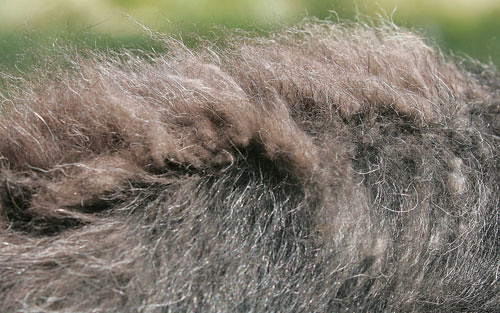
the Qiviut (down of the musk ox)  peeking through the guard hairs

Musk Ox male in Alaska

One of the baby musk ox 


The mighty muskox (Ovibos moschatu) is a survivor from the ice age. Possessing powerful curved horns, which hang down like side bangs from a helmet-like skullcap, muskoxen are actually more closely related to sheep and goats than to cattle and oxen (although all of the above are members of the Bovidae family). 

Adult muskoxen weigh from 180 to 400 kg (400 to 900 pounds) but they look much larger on account of their thick coats and large heads. Once muskoxen proliferated throughout the northern hemisphere alongside woolly mammoths, but hunting and habitat loss caused them to retreat further and further into the remotest parts of the north until the end of the nineteenth century when the animals could only be found in the unpopulated wilderness and empty islands of northern Canada and deep in the arctic vastness of Greenland. In these remote locations tiny herds of one to two dozen muskoxen still subsist on grasses, willows, lichens and moss while contending with terrible arctic predators and fearsome cold. 

Fortunately the muskox is provisioned with fearsome horns and doughty neighbours to fend off polar bears and wolves. The herd is capable of assembling in a ring formation with horns outward to stand off wolves and ice bears (although such a strategy works less well against humans with our projectile weapons). To fight the cold, the muskoxen have fat reserves and one of the most remarkable insulating coats in the animal world. 

A muskox’s coat is divided into two layers: a long stringy layer of coarse outer wool and an inner layer of soft warm undercoat called qiviut (this Inuit word now primarily denotes muskox wool but it was once also used to refer to similarly soft warm inner down of arctic birds). Qiviut is one of the world’s premier luxury fibres: it is allegedly 8 times more effective at insulation than sheep’s wool and yet is softer than cashmere. 

The Musk Ox survived when the other greats of the Pleistocene – woolly mammoth, mastodon, sabertoothed cats, giant sloth – all went away. And it returned to Alaska by way of New York Harbour. Now, it turns out, the musk ox could again be the great survivor in our new Arctic age of extinction. Ross MacPhee, a curator in the department of mammalogy at the American Museum of Natural History in New York City, says the musk ox’s homogenous genetic makeup suggests it has been through population stress before and can survive boom-and-bust cycles. 

“What we find with living musk oxen is they’re not exactly clones, but they’re so amazingly similar that there’s only one explanation,” MacPhee says. “And that explanation is that they had to have had a very severe pinch on their populations. We estimate that that happened about ten thousand years ago.” But that doesn’t mean it’s all good news for the cold-weather beast, which is most closely related to goats and sheep and can weigh up to 800 pounds. The pace of these changes could challenge even an animal as resilient as the musk ox, scientists say. 

Brendan Kelly, an Arctic ecologist and research scientist for the National Oceanic and Atmospheric Administration, says all Arctic species are currently endangered by the rapid speed of climate change. “For organisms to adapt – whether it’s changing body size, or changing the timing that they have their calves, and hence can match when the plants are most nutritious – it really depends on the rate of the environmental change relative to the generation time of the organism,” Kelly says. “So if there’s a really, really rapid environmental change, it’s very hard for there to be an adaptive response.” 

As I was reading about Musk Ox I found out that all of the muskox at the Myskoxcentrum in Härjedalen, Sweden, came from Ryøya, near Tromsø, Norway. What?!? Muskox on Ryøya? I knew about the Dovrefjell group and an attempt to introduce muskox on Svalbard, but I had never heard of a group in northern Norway. The search was on. 

It turns out that there is a flock of more 40+ animals now running around free on a small island named Ryøya off the coast of Tromsø. NRK’s Ut i naturen television program made a 24-minute show about “Moskusøya” (“Muskox Island”) in 2006. Unfortunately the show is in Norwegian, but even if you don’t speak Norwegian, it’s still worth watching for a while if you want to see muskox running around and scientists trying to catch them. In the Ut i naturen program, we also get to see some historic television clips from the 1960s when the muskox first came to Troms. 

In 1969, 25 muskox calves arrived in northern Norway via boat from Greenland. The idea was to raise muskox for their wool as domesticated livestock. The University of Fairbanks in Alaska had some kind of research project related to muskox husbandry (I haven’t looked into that yet) and the idea was transferred to Norway.

The undercoat wool of muskox, known as qiviut, is a highly valuable wool: it is warmer than wool, finer than cashmere and hypoallergenic. Sounds like the perfect winter clothing material, except that muskox are pretty rare and not widely domesticated – which makes it a very, very expensive material 

In 1969, the herd was established at a farm in Bardu with the hope that eventually every farm in the area could have 2-3 muskox for a meaningful supplementary income. But by 1975, calls for the end of muskox experiment were being made. According to media reports, a hunter was killed by a muskox and the muskox population was being devastated by a virus (hmmm, sounds familiar, right?). So in 1976, the herd was moved to northern Troms, and five years later, the Tromsø University is taking care of them to preserve the species. 

The Department of Arctic and Marine Biology took over the herd and moved them to Ryøya to study their behaviour and adaptation as arctic animals. Muskox as livestock in Norway didn’t work out, but who knows what the future holds. The Qiviut are still here.

While the scientists herd the muskox to collect measurements and/or for transportation to the overwintering station on the mainland, they quickly pull out the qiviut, which they sell to support their research. Qiviut is a bonus of having muskox in Norway — if you can catch them. 

Well , don’t you worry I caught some of it for you to support the musk ox population growing not only on the American continent but also in other habitats that are good for them. This will enable the species to grow, get stronger, adapt and hey, probably outlive us all, since they already did that to the woolly mammoth. 

Don’t worry, if I EVER find a woolly mammoth, I will share its’ wool with all of you … 

As far as rare breeds are concerned and especially with the musk ox, they are being monitored by scientists to see what is happening with the herds and what their health is. A musk ox can be up to two metres long. The animal is characterised by a long and dense coat and wide hooves and drooping horns. Like domestic cows, musk oxen are ruminants, and allow their food to ferment in a separate stomach prior to digesting it. Musk ox are well protected against the cold Arctic winter. They have two layers of hair--a thick undercoat and heavy outer coat of long, dark hair. Musk ox are a key species in the Arctic, but populations are in decline. A new method is helping scientists to monitor these animals in often difficult to reach, remote locations.

A new method of hair analysis reveals what musk ox in the Arctic have been eating in recent years. The hair is sampled from the animals’ buttocks where it is longest and preserves a longer time series of the animals eating habits. Buttock hair also grows continuously throughout the year and so it gives the most representative picture of the animals’ yearly food intake. “Musk ox [are] a key species in the Arctic that we know surprisingly little about,” says lead author Jesper Bruun Mosbacher, a PhD student at the Arctic Research Centre, Aarhus University, Denmark. “We use a new method that has never been applied in this way before. And we can use it to monitor [musk ox] populations in locations where we otherwise wouldn’t visit very often,” says Mosbacher.

Musk ox are found throughout the Arctic, in Greenland, Canada, Alaska, Norway, and Russia. And some local populations are thriving. 
In west Greenland, populations have soared from just 27 in the early 1960s to around 25,000 estimated individuals today, says Mosbacher. But scientists still do not know where most musk ox are or how they are faring. "No one knows how many there are among the [unmanaged] population on the east coast [of Greenland]. The most recent estimate in 1990 was between 2,900 and 4,600 musk ox within the area of the Zackenberg research station," says Mosbacher.

Mosbacher and his colleagues analysed hair from ten Greenlandic musk ox and discovered that the animals’ diet is directly linked with their environmental surroundings and the number of calves born. Fewer calves were born during and after particularly snowy winters.


"In winters with lots of snow, the animals starved and burned their layer of body fat. Musk ox live in such extreme areas and they are very dependent on sufficient body resources both to survive and to be able to produce calves," says Mosbacher.


 The scientists analysed the stable isotope composition of the hair, which indicates the type of food that the animals ate in recent years. An isotope is a specific version of an element and every element has several different isotopes. A stable isotope means that it is not radioactive and does not change into another isotope by radioactive decay.

The analytical tool is useful when predicting future population trends in the face of climate change, says Mosbacher. “Our study tries to understand how climate influences the musk ox’s diet, in a region where [climate] is changing twice as fast as in other ecosystems and where populations [of musk ox] are declining,” he says.


“Understanding the connection between the environment and food is important, because then we can begin to understand what will happen as the climate changes."
This new Tundra blend top are perfectly blended  super fine fibres which will make fine spinning very easy and more homogenous. 
It is not only easier to spin but also a very nice overall halo once spun into yarn. I love this blend and I hope you do too !
Have a wonderful long weekend with lots of happy crafting !
Don't  forget to do some Easter egg hunting on the IxCHeL website on Sunday April 9th at 12pm AEST. ! It is going to be FUN with lots of prizes to be won !
Big hugs
Charly